Two players take different roles
The computer is the shared investigation desk. The Chrononaut and Detective scan in with separate phones, each keeping a personal flashlight and role-specific abilities.
One piece of evidence. Three layers of time.
The truth becomes whole only when two abilities meet.

Three years ago, investigator Gu Yan vanished from this apartment. Players build an evidence chain across temporal traces, forensic relationships, and room mechanisms, deciding which apparent answers are only the outer shell of a lock.
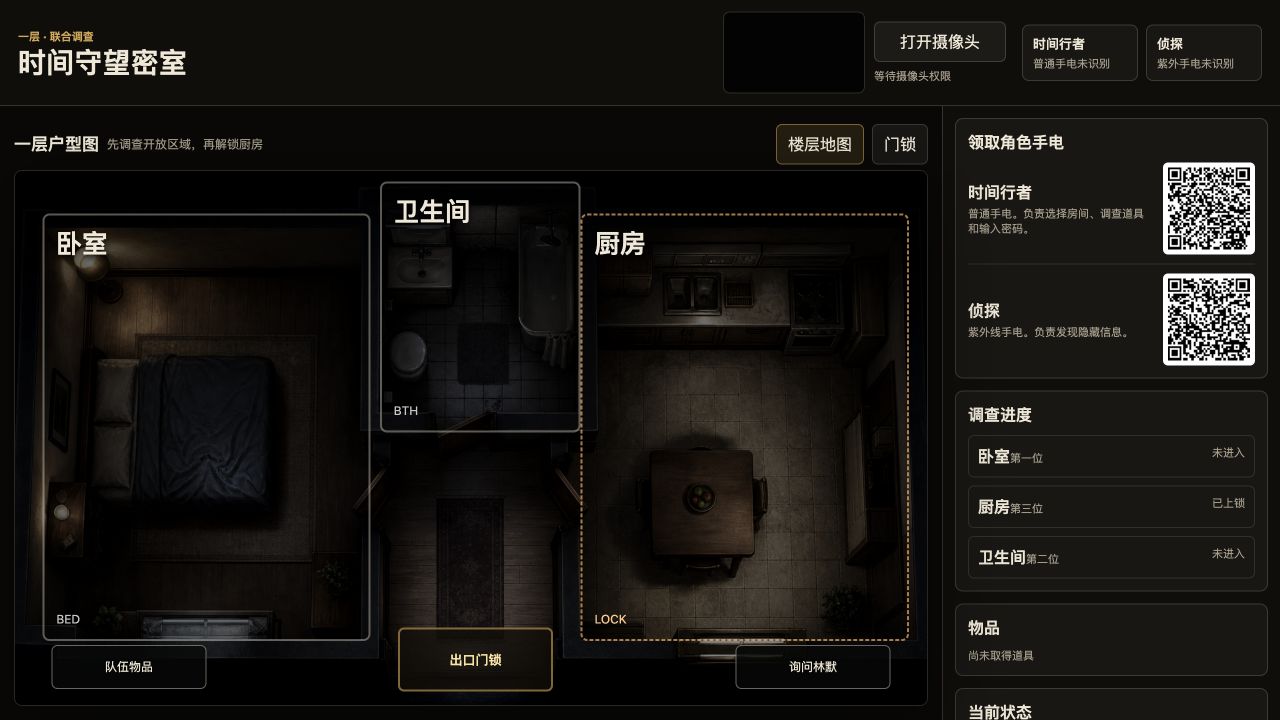
The computer displays connected roles, room states, shared items, NPCs, and achievements. Bedroom and bathroom clues first form kitchen code 72; after the kitchen opens, evidence from all three rooms forms 724.
The computer is the shared investigation desk. The Chrononaut and Detective scan in with separate phones, each keeping a personal flashlight and role-specific abilities.
The Chrononaut shifts between Past 20:10, Anomaly 20:25, and Present 20:40 to scan the traces left by the same evidence at different moments.
The Detective reads relationships between evidence with UV light, fingerprint powder, a structure lens, and a reagent dropper, locating the bedroom, bathroom, and kitchen digits.
The bedroom blowdart requires the Chrononaut to aim while the Detective blows into a phone microphone. Exchanging information becomes synchronized physical action.
Photographs, a valve, and a projector form one connected path. The final exit opens with code 724, the restored note, and the time insignia.
The Chrononaut reads time; the Detective reads evidence. Each phone is simultaneously a flashlight, a forensic workstation, and a physical input device.
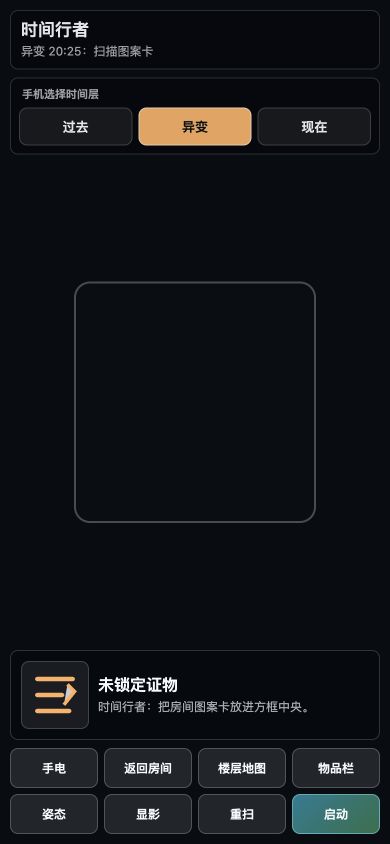
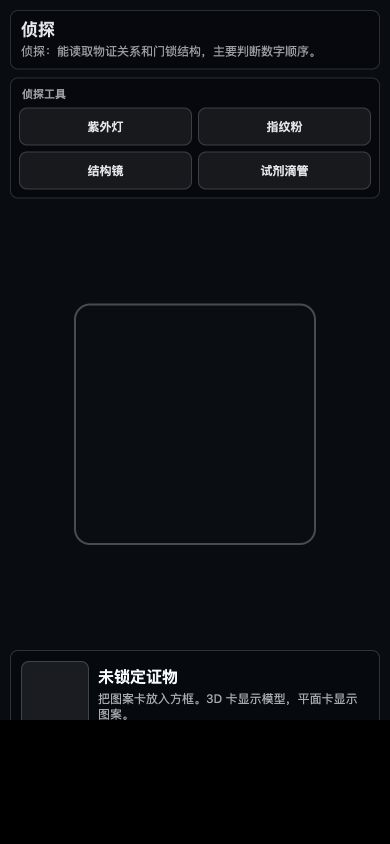
The two-person blowdart moves cooperation beyond telling someone an answer: one player aims while the other blows into a microphone to fire.

Modular case packsRooms, roles, items, time layers, and puzzles live in independent case data, so new stories do not rewrite the core runtime.
Reconnect and continuePhones preserve role identity after reconnecting. A refreshed computer restores room, inventory, puzzle, and lock progress for real event conditions.
Dual tracking fallbackThe computer camera tracks the phone light when possible; phone motion takes over when recognition is unavailable, keeping the experience moving.
The player-facing experience now contains only the main computer view, two phone roles, and printed marker cards. The level editor remains an internal production tool rather than part of the public game interface.
BACK TO ALL WORK ←